Origin of avian flight
Moving past the ground-up versus trees-down debate by testing flight-origin models against a time-calibrated paravian record.
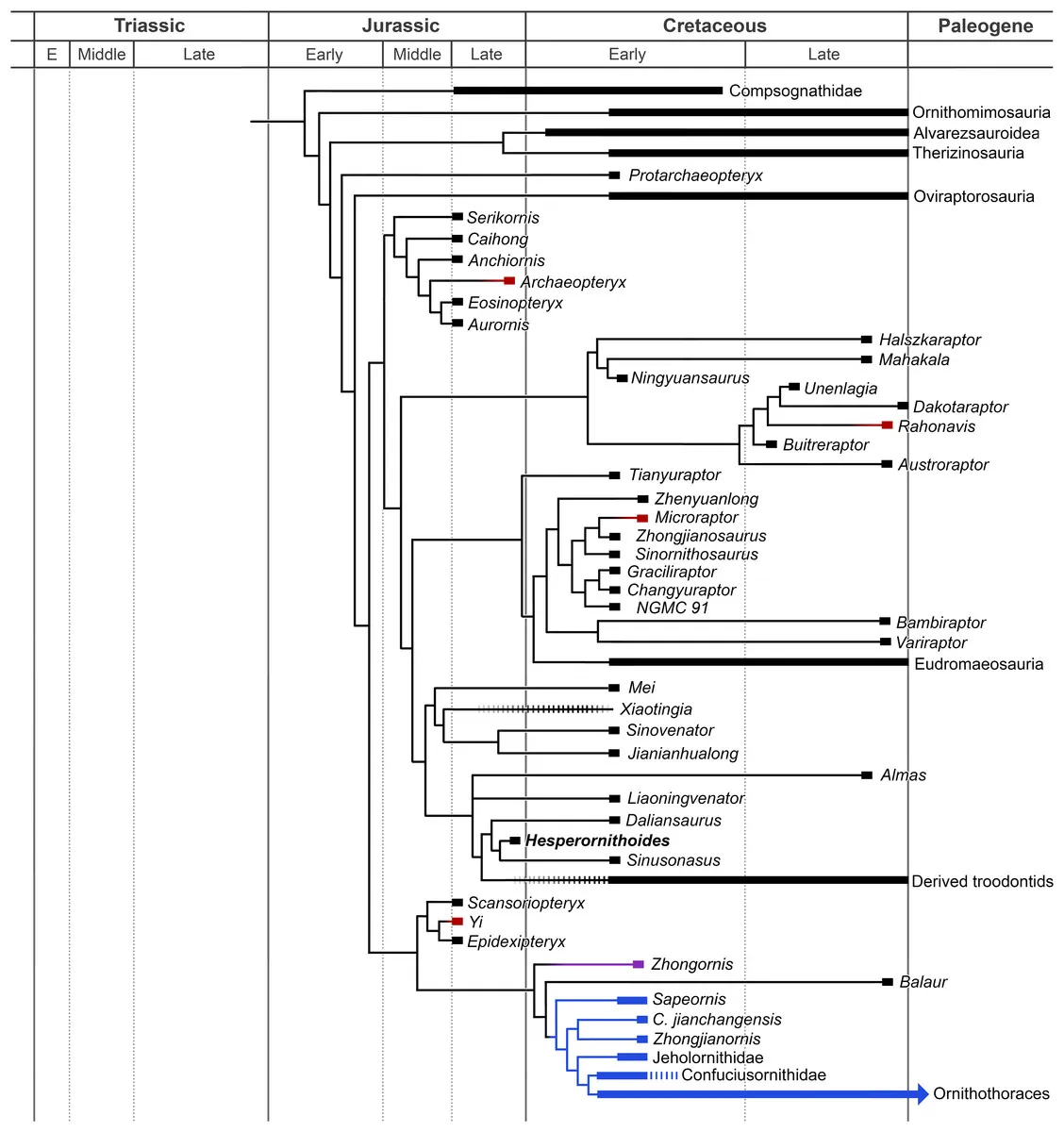
The origin of birds from theropod dinosaurs is one of the great locomotory transitions in the history of life. Unlike the situation with basal members of the other flying vertebrate clades, bats and pterosaurs, the fossil record of early flying dinosaurs is remarkably complete, including excellent preservation of taxa with incipient flight anatomy. That means the ecological context and selective pressures that drove the transition to avian flight can be documented in a detail rarely available to us.
I have been working on the origin of birds for over two decades. My first platform presentation, at the 2000 Society of Vertebrate Paleontology meeting, was on the topic (Primary and caudal feathers as locomotory adaptations in maniraptoran theropods). Ongoing goals include disentangling the “ground up versus trees down” debate, building a framework that lets competing models of bird origins be tested more explicitly against the fossil record, and documenting how the history of dinosaur research and typological thinking has shaped modern ideas about bird origins (spoiler: not for the better).
Papers and presentations from this work, and the colleagues who have collaborated on it, are listed below.
Papers
- 2025
Forelimb feathering, soft tissues, and skeleton of the flying dromaeosaurid Microraptor
Grosmougin M, Wang X, Zheng X, Kaye TG, Chotard M, Barlow LA, Dececchi TA, Habib MB, Zariwala J, Hartman SA, Xu X, Pittman M
BMC Ecology and Evolution 25(1): 6510.1186/s12862-025-02397-5
- 2025
New information on the hind limb feathering, soft tissues and skeleton of Microraptor (Theropoda: Dromaeosauridae)
Chotard M, Wang X, Zheng X, Kaye TG, Grosmougin M, Barlow L, Kundrát M, Dececchi TA, Habib MB, Zariwala J, Hartman SA, Xu X, Pittman M
BMC Ecology and Evolution 25(1): 3710.1186/s12862-025-02372-0
- 2022
Preserved soft anatomy confirms shoulder-powered upstroke of early theropod flyers, reveals enhanced early pygostylian upstroke, and explains early sternum loss
Pittman M, Kaye TG, Wang X, Zheng X, Dececchi TA, Hartman SA
Proceedings of the National Academy of Sciences 119(47): e220547611910.1073/pnas.2205476119
- 2019
A new paravian dinosaur from the Late Jurassic of North America supports a late acquisition of avian flight
Hartman S, Mortimer M, Wahl WR, Lomax DR, Lippincott J, Lovelace DM
PeerJ 7: e724710.7717/peerj.7247
- 2017
Basal paravian functional anatomy illuminated by high-detail body outline
Wang X, Pittman M, Zheng X, Kaye TG, Falk AR, Hartman SA, Xu X
Nature Communications 8(1): 1457610.1038/ncomms14576
- 2007
The tenth skeletal specimen of Archaeopteryx
MAYR G, POHL B, HARTMAN S, PETERS DS
Zoological Journal of the Linnean Society 149(1): 97-11610.1111/j.1096-3642.2006.00245.x
Conference abstracts & talks
- 2025
New Microraptor specimens bring insight into the forewing anatomy and its impact on flight behavior and ecology
Grosmougin M, Wang X, Zheng X, Kaye TG, Chotard M, Barlow LA, Dececchi TA, Habib MB, Zariwala J, Hartman SA, Xu X, Pittman M
International Congress of Vertebrate Morphology
- 2025
Transition from occasional to habitual theropod flyers: origin of regular flight use in early birds and their close relatives
Dececchi TA, Habib MB, Hartman SA, Larsson HCE, Pittman M
International Congress of Vertebrate Morphology
- 2021
Operationalizing a late origin of avian flight
Hartman SA, Fitch A
Northeast Natural History Conference (online)
- 2019
Internal and external flight-related anatomy of early theropod fliers revealed by laser-stimulated fluorescence fills knowledge gaps in functional morphology and flight capability
Pittman M, Kaye TG, Wang X, Zheng X, Hartman SA, Xu X
Society of Vertebrate Paleontology 79th Annual Meeting
- 2019
Origin of Pterosauria and stepwise evolution of the pterosaurian flight apparatus
Fitch A, Pritchard A, Hartman SA, Bevitt J, Lovelace DM, Bhullar BA
Geological Society of America Annual Meeting, Phoenix10.1130/abs/2019AM-340860
- 2018
A testable macroevolutionary framework for character acquisition in the origin of avian flight
Hartman SA, Mortimer M, Lovelace DM
Society of Vertebrate Paleontology 78th Annual Meeting
- 2018
Adaptive diversity in the early evolution of theropod flight
Pittman M, Wang X, Kaye TG, Zheng X, Hartman SA, Navalón G, Xu X
International Pennaraptoran Dinosaur Symposium, Hong Kong
- 2018
Laser-stimulated fluorescence reveals preserved soft tissues which unravel the complexity of avian flight evolution
Pittman M, Kaye TG, Wang X, Zheng X, Hartman SA, Navalón G, Xu X
5th International Palaeontological Congress (IPC5), Paris
- 2017
New information on a paravian theropod from the Morrison Formation
Hartman SA, Mortimer M, Wahl WR, Lomax DR, Lovelace DM
Society of Vertebrate Paleontology 77th Annual Meeting
- 2016
Nothing but skin and bones: Anchiornis body outline revealed by laser fluorescence
Kaye TG, Pittman M, Wang X, Zheng X, Xu X, Hartman SA, Falk AR
Society of Vertebrate Paleontology 76th Annual Meeting
- 2007
Re-evaluating wing shape in Archaeopteryx: information from the Thermopolis specimen
Hartman SA
Society of Vertebrate Paleontology Annual Meeting
- 2005
Phylogenetic assessment of a maniraptoran from the Morrison Formation
Hartman SA, Lovelace DM, Wahl WR
Society of Vertebrate Paleontology Annual Meeting
- 2000
Primary and caudal feathers as locomotory adaptations in maniraptoran theropods
Hartman SA
Society of Vertebrate Paleontology Annual Meeting