Physiological modeling
Linked microclimate and heat-balance models that ask where extinct animals could actually live.
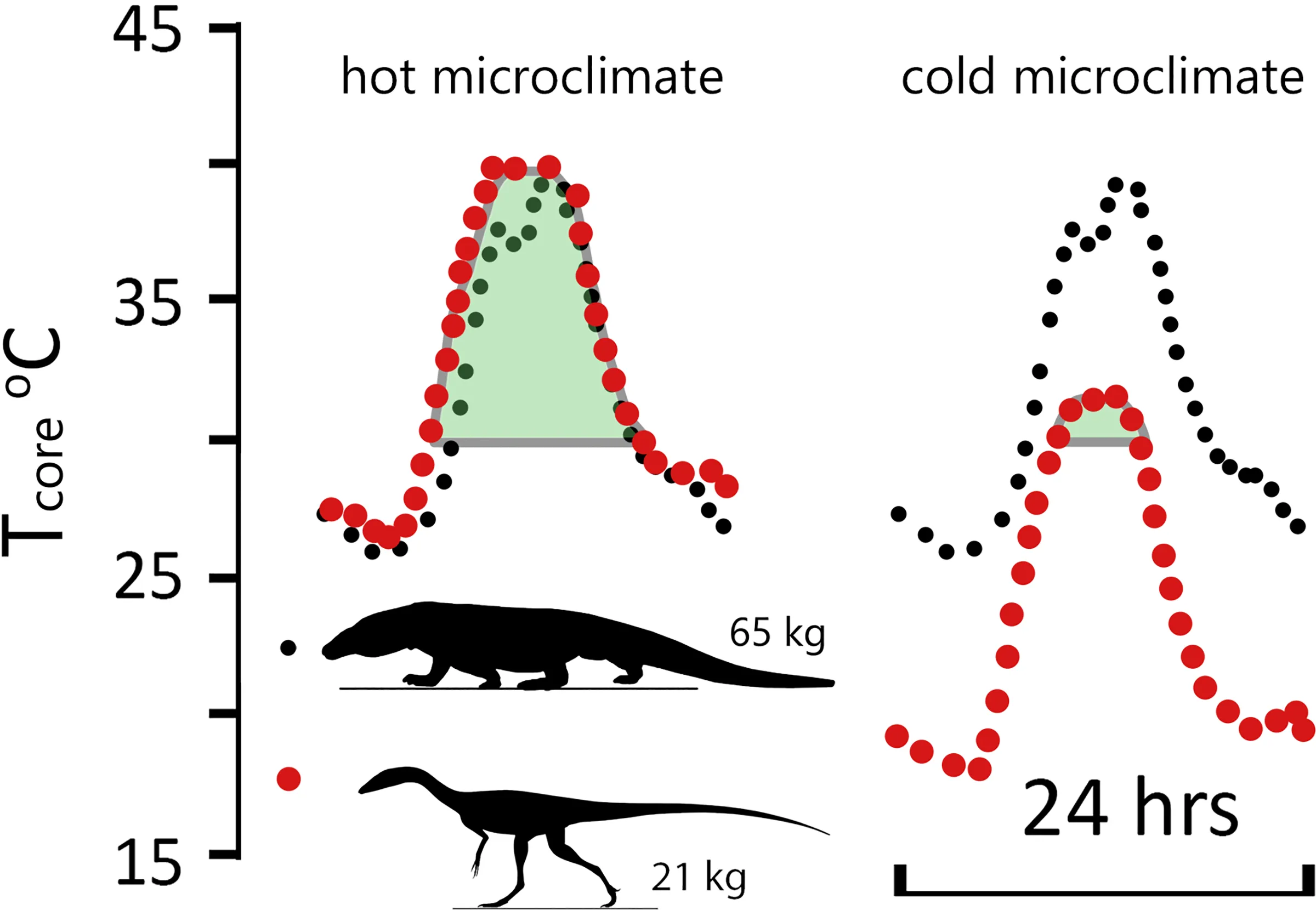
In 2012 I joined Warren Porter, David Lovelace, and Paul Mathewson to apply Niche Mapper, a mechanistic model of the heat and water exchange between an animal and its environment, to extinct vertebrates.
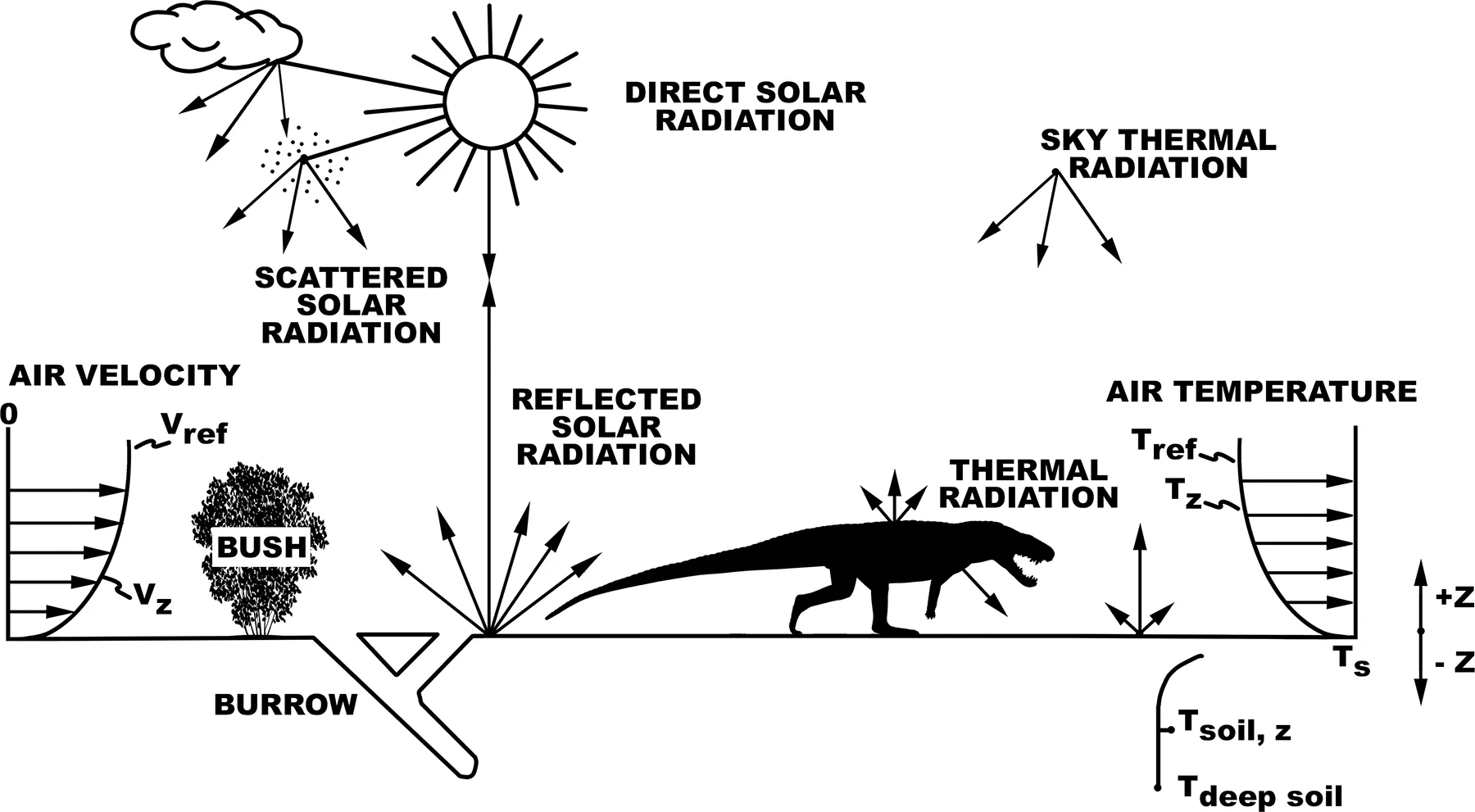
Niche Mapper pairs a microclimate model, which rebuilds the hour-by-hour temperatures, wind, humidity, and radiation an animal would experience, with an animal model built from body size and shape, posture, insulation, and metabolism. Rather than asking whether a dinosaur was “warm-blooded,” it lets us ask which combinations of metabolic rate, insulation, and body size could survive in a given environment, and where.
Our first test case, Modeling Dragons (Lovelace et al. 2020), examined Late Triassic dinosaurs from the Chinle Formation. It found support for elevated, ratite-like metabolic rates, and suggested that large prosauropods would have been heat-stressed in open, hot environments. Follow-up work extended the approach to predict the biogeographic distribution of Late Triassic terrestrial amniotes (Hartman et al. 2022), and my dissertation applied it to macroevolution, thermal ecology, and extinction in Mesozoic tetrapods.
Papers
- 2022
Mechanistic Thermal Modeling of Late Triassic Terrestrial Amniotes Predicts Biogeographic Distribution
Hartman SA, Lovelace DM, Linzmeier BJ, Mathewson PD, Porter WP
Diversity 14(11): 97310.3390/d14110973
- 2020
Modeling Dragons: using linked mechanistic physiological and microclimate models to explore environmental, physiological, and morphological constraints on the early evolution of dinosaurs
Lovelace DM, Hartman SA, Mathewson PD, Linzmeier BJ, Porter WP
PLOS ONE 15(5): e022387210.1371/journal.pone.0223872
- 2020
Macroevolution, thermal ecology and extinction in terrestrial Mesozoic tetrapods
Hartman SA
PhD dissertation, University of Wisconsin–Madison
Conference abstracts & talks
- 2021
Thermal ecology drove survivorship patterns of terrestrial vertebrates across the end-Triassic extinction
Hartman SA
Triassic Vertebrate Paleontology Meetup
- 2016
Mechanistic physiological modelling predicts geographic distribution of Late Triassic tetrapods
Hartman SA
Society of Vertebrate Paleontology 76th Annual Meeting
- 2015
Using ecological modelling to quantify thermal constraints on two Late Triassic dinosaurs
Hartman SA, Lovelace DM, Linzmeier BJ
Society of Vertebrate Paleontology 75th Annual Meeting